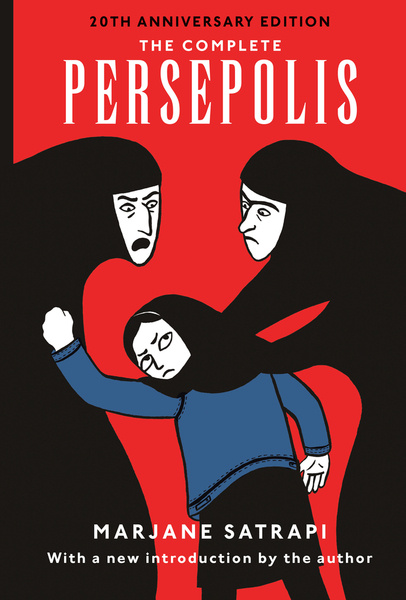
Persepolis
By Marjane Satrapi
Published 2004
3 min read
It’s a memoir / autobiography of the author growing up as a girl during the Iranian Cultural Revolution. While she clearly loves her country and is proud of the history and culture, she is incredibly critical of the religious and oppressive forces emanating from the authoritarian regime.
Her family was highly educated. As a young child for example she knew all the famous revolutionaries both foreign and domestic like Castro and che guava. From a young age she was aware her parents were politically active in demonstrations and protests. She immersed herself in books and manifestos as did a lot of her friends and classmates. This wasn’t a cultural revolution that passed easily. There was significant opposition. But the regime was brutal in its enforcement. Imprisonment, torture, and even executions if you didn’t comply with the new rules.
Iran was moving towards secularism and the West both politically and culturally for much of the early to mid 20th century. Iran then looked very similar to the US and there is a meme being passed around that illustrates this.
Why Iran made a hard rejection of this and shifted to religious fundamentalism is largely a reaction to disastrous foreign policy by the United States and Great Britain. This foreign policy prioritized short term domestic corporate oil profits that then covertly overthrew the government of Iran, twice!, to install a puppet leader who was even friendlier to western interests. The problem was he was incredibly unpopular in Iran. Eventually the people revolted and the religious right, which had always been bubbling in Iran, exploded and swung the pendulum of religious fundamentalism - hard. This was the Iranian Cultural Revolution of 1979.
She was a little girl during this and she remembers going to school and not understanding why she had to wear a shawl all of a sudden. She and the other girls did what kids do and mess with it. They would throw it or play with it.
This story of her as a girl childishly disrespecting something that would eventually throw so many thousands of women annually in prison is something I found incredibly humanizing. Ah yes, of course there were people who opposed extreme religious fundamentalism. It’s this viewpoint that Marjane Satrapi offers us and I’m incredibly grateful that she has.
The rest of the book follows Marjane as she grows up and lives a life within the oppressive society that she finds herself in. Within this society we see friends and family members living their lives, both public and private. Some find ways to cope, some accept it, others hide it and some of those pay for it.
Then Iraq invades Iran. Marjane’s pre teen years are arguing with her repressive teachers and trying to live in a bombed Tehran. There are incredible moments of tragedy and infuriating scenes of oppression. Eventually her parents decide it’s best for her to leave Iran and live with an Aunt in Vienna.
Vienna is not much better. Alone and largely isolated. She again argues with her teachers and gets expelled again. She tries to come to grips with coming of age. She befriends a group of punks and tries drugs for the first time. She also finds love and has her heart broken. She was living with her boyfriend at the time and found herself homeless in Vienna. After a bout of bronchitis that lands her in the hospital she calls her parents and flies back home to Iran.
Back in Iran after several years and she is now a young woman. She struggles just as much as she did before. She marries and divorces an Iranian.
- Posted on Mon, 29 Jun 2026
Review Graphic Novel Iranian Memoir Autobiography ReadingLatest Articles

The Dad Coach
4 min read
Posted Tue, 08 Sep 2026

The Aeronaut's Windlass
6 min read
Posted Thu, 27 Aug 2026
Persepolis
3 min read
Posted Mon, 29 Jun 2026

The Alchemist
5 min read
Posted Sat, 06 Jun 2026
The Maltese Falcon
1 min read
Posted Sun, 25 Jan 2026